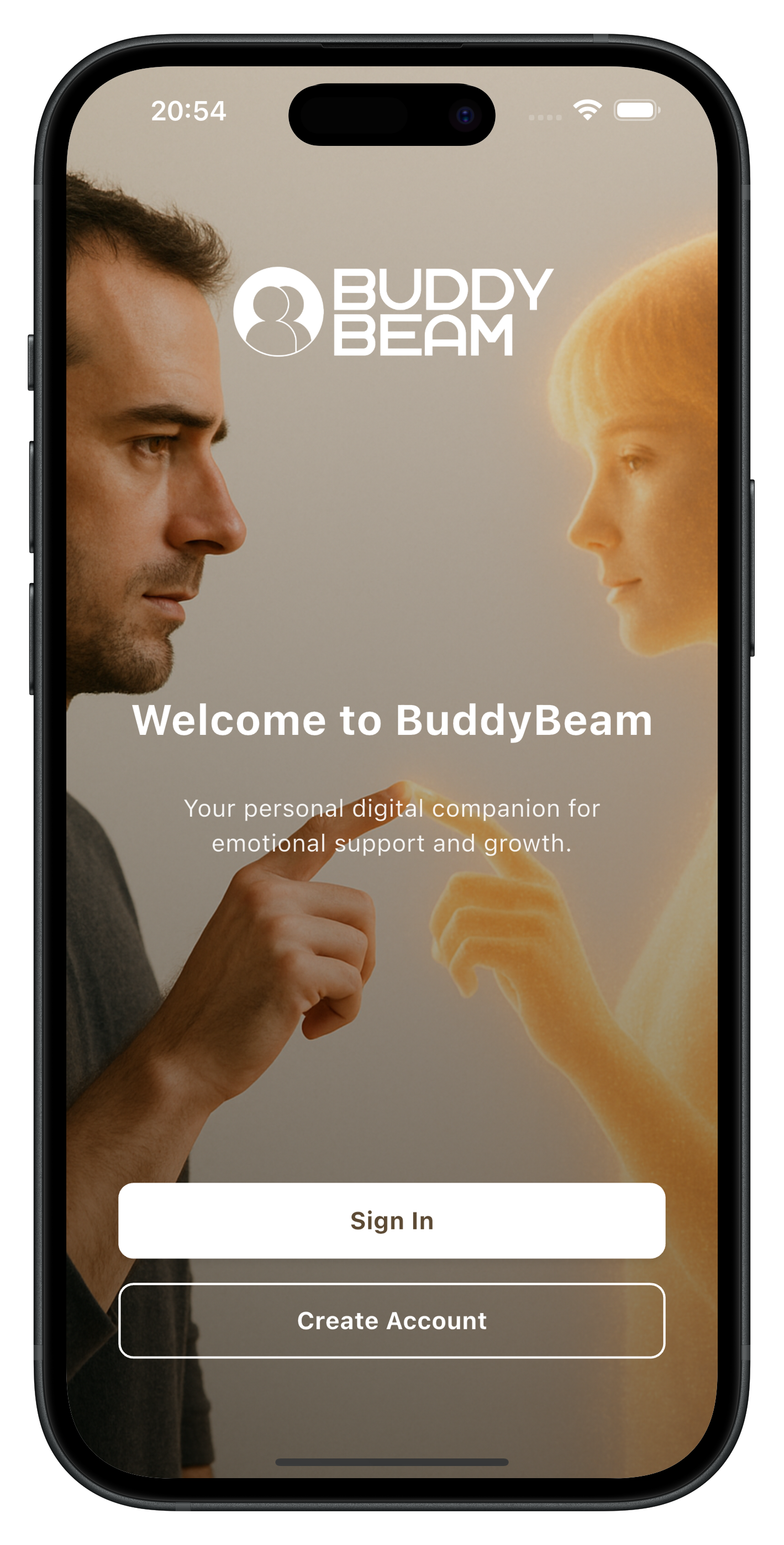
Why does talking to a digital person feel different from chatting with an AI?

Over the past few years, AI chatbots have gone from being a technical curiosity to becoming an everyday tool. Models like ChatGPT, Claude, or Gemini are used daily for writing, answering questions, programming, or making decisions.
However, many people describe a clear feeling: chatting with an AI doesn't feel the same as talking to someone, even if that "someone" is digital.
Why does this happen? What changes when we move from text to presence?
The current AI chatbot ecosystem: what they offer and what they don't
To understand the difference, it's worth first observing what types of experiences exist today within conversational AI.
ChatGPT (OpenAI)
- Exceeds 700 million weekly active users in 2025, according to public estimates.
- Primarily utilitarian use: writing, learning, productivity.
- Text-based interaction, even when voice is added.
Claude (Anthropic)
- Stands out for coherence, reasoning, and reflective tone.
- Widely used for analysis, writing, and long conversations.
- Abstract experience: conversation without presence.
Character.ai
- Conversations with fictional or customized characters.
- High narrative and creative component.
- The user is aware they're interacting with a character, not a real social presence.
Replika
- Oriented towards companionship and emotional support.
- Introduces avatar and voice, but with limited interactions and not fully in real-time.
- Has generated debates about emotional dependency and ethical AI design.
All these systems are powerful, but they share a common trait: the interaction occurs on a symbolic plane, not a social one.
Text is not presence (and the brain knows it)
Although a chatbot generates empathetic responses, the human brain processes that information differently from real social language.
Studies in neuroscience and social psychology show that:
- The brain responds differently to a human voice than to written text.
- Eye contact, silences, and synchrony activate automatic social circuits.
- Tone and rhythm influence emotional perception more than literal content.
When you write to a chatbot:
- You read.
- You interpret.
- You analyze.
When you talk to a digital person in real-time:
- You react.
- You respond emotionally.
- You synchronize with the interaction.
The difference is not technological. It's biological.
What changes when a digital person with AI appears
A digital person is not simply "an AI with a face". It changes the nature of the conversation.
1. Real-time conversation
There's no cognitive friction from reading and writing. The interaction flows like a human conversation.
2. Non-verbal communication
Gestures, facial expressions, pauses, and eye contact. More than 60% of human communication is non-verbal, and traditional chatbots don't access that layer.
3. Sense of reciprocity
You don't just receive information. You feel there's a presence that listens, responds, and adapts.
That's why many people describe these experiences as:
- More personal
- More immersive
- More "real", even knowing they're artificial
Anthropomorphism: it's not weakness, it's evolutionary design
Human beings are programmed to attribute intention and mind to any entity that:
- Looks at us
- Responds coherently
- Shows emotional continuity
It's not naivety. It's a basic social mechanism.
When a conversational AI with an avatar combines voice, face, and contextual memory, the brain activates the same circuits as in a simple social interaction, even though we rationally know there's no consciousness behind it.
This doesn't imply deception. It implies responsibility in artificial intelligence design.
The ethical limit: presence is not substitution
This is where many platforms fail.
Recent data indicates that:
- Approximately 1 in 3 young users in Europe has used an AI to talk about emotions in the last year.
- Cases of emotional dependency have been documented when systems present themselves as "friends" or social substitutes.
The problem is not the technology. The problem is what it promises.
A well-designed digital person:
- Does not replace human relationships
- Does not present itself as an exclusive bond
- Does not encourage emotional dependency
It accompanies, practices, trains, supports. It does not substitute.
So, why does it feel different?
Because you're not just interacting with language, but with complete social signals.
| Type of experience | What it offers | How it's perceived |
|---|---|---|
| Text-based AI chatbot | Information and reasoning | Useful, efficient |
| Character chat | Narrative and entertainment | Fun |
| Digital person with real-time AI | Presence and social interaction | Personal, immersive |
It's not an incremental improvement. It's another category of experience within artificial intelligence.
Conclusion
Chatting with an AI is conversing with a system. Talking to a digital person feels more like interacting with someone.
The difference is not just in the model, but in the experience: voice, real-time, presence, and clear limits.
The future of artificial intelligence is not just about smarter responses, but about more human, responsible, and conscious interactions.
That's what we're offering at BuddyBeam: real-time conversations with AI-powered digital people, designed to feel closer than a traditional chatbot, within an approach of human-centered artificial intelligence, aligned with European, ethical, and responsible values.
Try it Free
Sign up and meet your digital companion today.